What’s New in BLE Beacon Innovation: Smarter, Faster, More Accurate in 2025
Bluetooth Low Energy (BLE) beacon systems have become the backbone of indoor location tracking, factory automation, and proximity-based services in 2025. From smart factory forklift tracking to indoor asset management, BLE technology is transforming how we sense, automate, and interact with real-world environments. But what exactly is new in BLE beacon innovation this year?
Let’s explore how BLE beacons have evolved to become smarter, faster, and more accurate—and why industries are shifting away from GPS and Wi-Fi in favor of BLE.
Smarter Beacon Hardware: AI at the Edge
In 2025, BLE beacons are no longer just signal broadcasters. The latest generation integrates edge AI chips for on-device intelligence. These beacons can detect motion, direction, temperature, and even human presence without relying on a central system.
This allows real-time event detection like unauthorized movement of assets, forklift idling, or occupancy monitoring in workspaces. Edge-AI-enabled BLE devices reduce cloud dependency, improve latency, and enhance privacy—especially in sensitive areas like healthcare or defense.
Battery life has also improved. Modern BLE tags use smart broadcasting techniques, enabling 3–5 years of usage on a single coin-cell battery.
Enhanced Location Accuracy Using Angle of Arrival (AoA)
Traditional BLE systems offered 3–5 meter accuracy, which was acceptable for general location tracking. In 2025, BLE systems support Angle of Arrival (AoA) and Time of Flight (ToF) to boost accuracy to sub-meter levels—ideal for indoor positioning and precise inventory tracking.
With the right antenna arrays and calibration, systems now track mobile assets like forklifts or robotic carts with accuracy down to 0.3 meters. This breakthrough is critical in smart warehouses where even a slight deviation can disrupt workflow.
Integration with MQTT for Scalable Data Streaming
BLE beacon deployments have grown from dozens to thousands of nodes per facility. Managing this scale needs lightweight, reliable messaging protocols. That’s why MQTT has become the backbone of BLE beacon communication in 2025.
MQTT ensures low-latency, real-time updates across networks with minimal bandwidth. Whether it’s forklift telemetry or environmental sensor data, MQTT enables seamless data transmission between BLE gateways and cloud systems.
This architecture supports plug-and-play scalability, allowing smart factories and retail chains to expand without reworking core infrastructure.
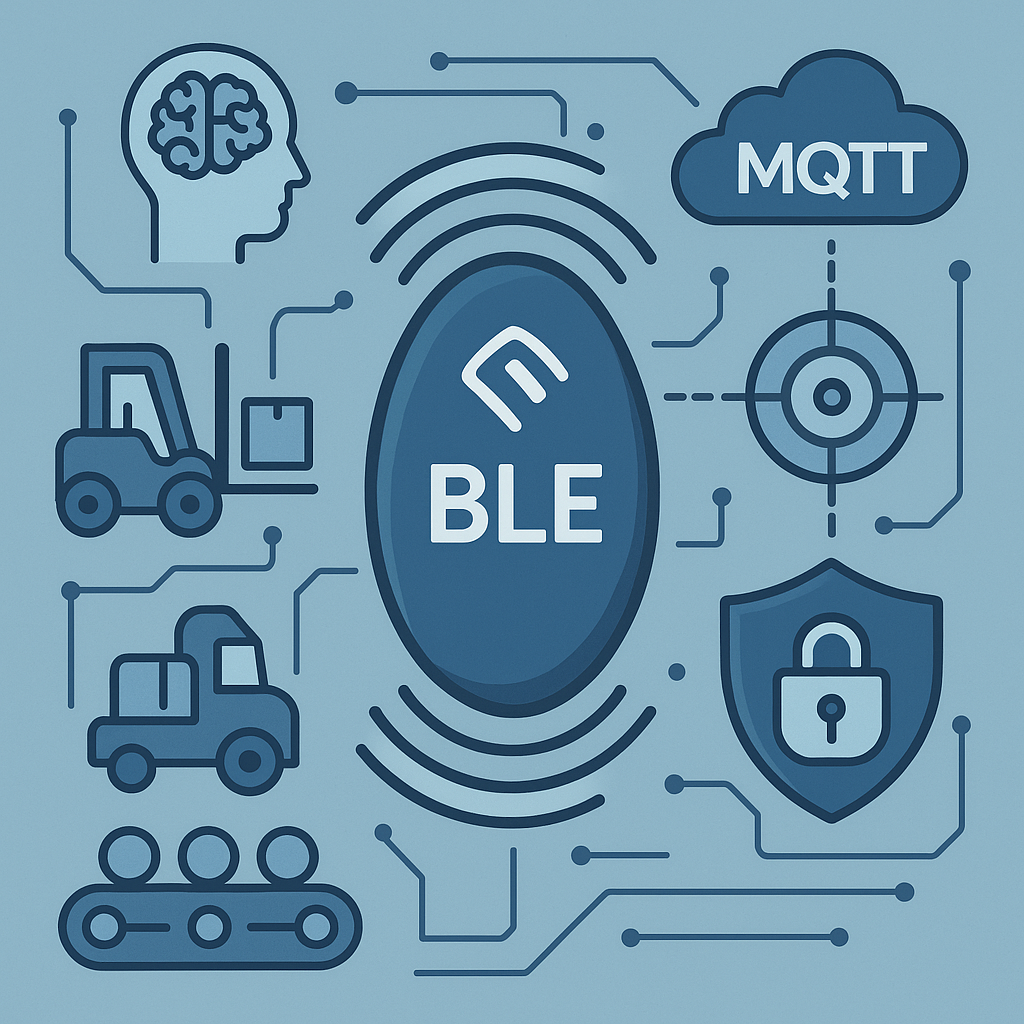
BLE + AI: Predictive Analytics and Behavior Detection
BLE beacons combined with AI now offer more than just tracking—they provide behavioral insights. Machine learning models analyze BLE movement patterns to detect inefficiencies or anomalies.
For example:
- Predictive maintenance for forklifts based on route deviation or idle time
- Employee safety monitoring through fall or distress signal detection
- Energy optimization by monitoring occupancy patterns in manufacturing units
Generative AI tools now process BLE telemetry data to suggest process improvements or generate reports automatically.
Use Case: Indoor Asset Tracking in GPS-Denied Environments
GPS fails indoors due to signal attenuation from walls and roofs. BLE beacons solve this with reliable, real-time indoor tracking. They are ideal for:
- Pallet tracking in warehouses
- Tool tracking in aerospace assembly plants
- Wheelchair tracking in hospitals
- Visitor movement analytics in exhibitions
One QTrace client reduced search time for inventory pallets by 80% using BLE and AI together. With zone-based alerts and visual heatmaps, they optimized staff deployment and improved order turnaround times.
Improved Security and Data Encryption
Security is a priority in 2025. BLE 5.3 now supports encrypted advertising, random address rotation, and secure pairing. This protects against spoofing and man-in-the-middle attacks, especially in environments like pharmaceuticals or banking.
Enterprises also prefer multi-factor authentication using BLE wristbands for worker identity and access control, integrating with existing ERP or HRMS systems.
Lower TCO with Gateway-Free Architectures
New BLE mesh networks enable devices to relay data directly, removing the need for multiple expensive gateways. These decentralized architectures reduce total cost of ownership (TCO) and simplify deployments in large-scale environments like airports or smart campuses.
Moreover, BLE beacon platforms now offer no-code configuration apps, enabling faster onboarding without IT involvement.
Future Outlook: BLE and UWB Convergence
In 2025, BLE is beginning to merge with Ultra-Wideband (UWB) for hybrid systems. BLE handles long-range location awareness while UWB offers centimeter-level precision in critical zones. Expect future smart factories to use dual-technology tags to balance cost and precision.
Companies like QTrace are pioneering hybrid BLE-UWB solutions with AI-based zone mapping and anomaly alerts.
Testimonial
“Before BLE, tracking our forklifts in real-time was a guesswork game. With the QTrace system, we not only track but also predict movement patterns and cut downtime by 40%.”
— Kunal Sharma, Smart Logistics Head, IndiaMart Fulfillment Center
For companies seeking scalable, low-power, and AI-ready location solutions, BLE beacons in 2025 are unmatched. Their integration with MQTT, edge AI, and smart mesh networking has redefined real-time visibility.
Explore how this transformative technology fits into your smart factory plans by visiting the BLE smart factory solution case study.


